
The Ghost in the Machine: How an Ancient Ocean Rewrote Australian Law
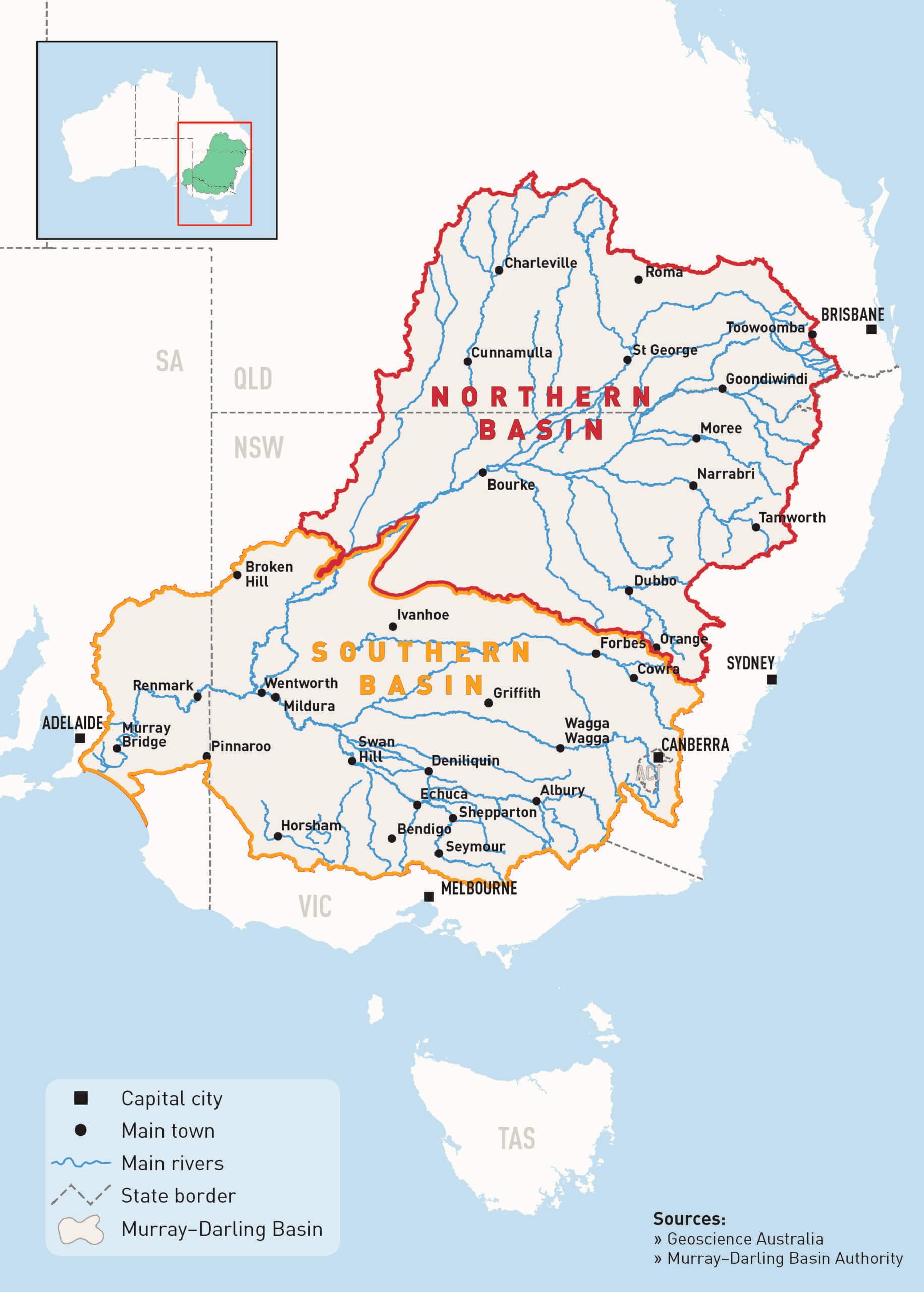
On January 23, 1830, Charles Sturt reached the junction of the Murray and Darling rivers in south-western New South Wales. For the British Empire, it was a cartographic success. For Sturt, it carried a familiar bitter taste. A year earlier, further north, he had found the Darling River “salt as brine.”
He was describing the outlet of a 100-billion-tonne saline inheritance. The remnant of an ancient inland sea, locked into soils and groundwater, would help force the creation of the Basin Plan 2012 two centuries later.
The Biophysical Reality vs. the Hydraulic Dream
For more than a century, Australian land management operated on a fiction: that the Basin was a bottomless sponge. Soldier settlements and irrigation schemes replaced deep-rooted native vegetation with shallow-rooted crops and pastures.
The hydrology changed with the vegetation. Without the biological pumps of native scrub, watertables rose, ancient salt stores dissolved, and salinity moved toward the surface. By the 1960s, the Murray had become a saline conveyor belt. The effort to make the inland productive was waking a geochemical inheritance it could not control.
The 1970 Gutteridge Turning Point
The 1970 Gutteridge Report marked a change in how the Basin was understood. It treated salinity not as a local inconvenience, but as a system problem. The Basin was effectively a closed landscape for salt: it entered, accumulated, and rarely left without intervention.
That diagnosis helped produce one of Australia’s most ambitious engineering responses: Salt Interception Schemes.
Today, 14 to 15 major schemes line the river. Pumps intercept saline groundwater before it reaches the channel and divert it into evaporation basins. Roughly half a million tonnes of salt are exported from the system each year to protect water quality for downstream users, especially Adelaide.
The Codification of Soil Harms: Schedule 10
The Basin Plan is often argued over as a fight about water rights and allocations. Its deeper biophysical honesty sits in Schedule 10.
Schedule 10 functions as a diagnostic chart for the landscape. It explicitly identifies soil degradation as a driver of water-quality decline. It acknowledges that:
- irrigation without adequate drainage mobilises salt stores
- the replacement of deep-rooted vegetation with shallow-rooted crops and pastures broke the evaporative balance that kept salt at depth
- high-sodium irrigation water drives a feedback loop of soil structure decline
In the language of Soil Security, this is Codification. It is a rare instance of legislation ceasing to treat the river as a pipe and starting to treat it as a working system inseparable from the soil profile.
Conclusion: The Social Contract
The Basin Plan did not solve the salinity problem. The salt remains. What the Plan did was force a political system to reckon with material limits it had long tried to out-engineer.
That is why it matters for soil security. It shows law responding, belatedly and imperfectly, to the fact that soil, groundwater, rivers, and infrastructure are not separate domains. They are one system, and they fail together.

by Julio Pachón Maldonado
Postdoctoral Research Associate in Soil Security
Julio Pachón Maldonado is a soil scientist whose work centres on soil security, particularly the dimensions of Connectivity—people’s awareness and engagement with soils—and Codification—the legal and policy frameworks that protect them. He has collaborated with stakeholders across Europe, Africa, South America, North America, and Australia, combining field-based pedological experience with advances in digital soil mapping and policy analysis. His current focus is on self-assessment tools that allow farmers, policymakers, and land managers to connect directly with the latest soil research in a personalised way, while also exploring how artificial intelligence can assess legislation and strengthen governance frameworks that bring soils into global sustainability debates.
Related Articles

From the FIFA World Cup Pitch to the Planet: What Football Can Teach Us About Soil Security
Image from Blair Ferguson, PITCHARE (Link: From research to reality: FIFA’s shallow pitch system debuts at the Cl | Pitchcare) Over the past month, millions of us have enjoyed the FIFA World Cup. We watched breathtaking goals, great saves, and unforgettable moments....
Getting lost with the soil: reflections on the Whithorn Way
The sun rises over St Ninian’s Priory and the remains of Whithorn Cathedral, on Stage 13 of the Whithorn Way. The natural environment can be truly stunning. Whilst conducting a soil sampling campaign in southern Scotland recently, I was fortunate enough to squeeze in...

23rd World Congress of Soil Science 2026: Connecting Science to Policy in Nanjing
Earlier this month, the global soil science community converged on the Nanjing International Expo Centre for the 23rd World Congress of Soil Science (WCSS). Hailed as the “Olympics of Soil Science”, this marks the first time in the event’s nearly 100-year history that...