
From the FIFA World Cup Pitch to the Planet: What Football Can Teach Us About Soil Security
Image from Blair Ferguson, PITCHARE (Link: From research to reality: FIFA’s shallow pitch system debuts at the Cl | Pitchcare)
Over the past month, millions of us have enjoyed the FIFA World Cup. We watched breathtaking goals, great saves, and unforgettable moments. Behind every remarkable match is something that most fans never see: the soil beneath the pitch.
Long before the world’s greatest players step onto the pitch, soil scientists, turfgrass specialists, and engineers spend months designing the perfect playing surface.
A World Cup pitch is a carefully engineered soil system. Without the right soil beneath the surface, even the world’s best footballers wouldn’t be able to perform at their best.
Why Is the Soil so Special?
A FIFA World Cup pitch is much more than a field of grass.
The soil is carefully designed to provide the perfect balance of firmness, drainage, moisture, and air. It should be strong enough to support players running at full speed while remaining soft enough to reduce the risk of injury.
Unlike many natural soils, World Cup pitches are usually built using a specially engineered sand-based rootzone. This allows water to drain quickly after rain, prevents waterlogging, and encourages healthy grass roots, resulting in no muddy pitches, better footing for players, and a faster and smoother game. Imagine playing a World Cup final after heavy rain. Without this engineered soil, the pitch could quickly become muddy, slippery, and unsafe. This is why many of the world’s best football pitches are built on sand rather than natural topsoil.
Every pass, tackle, and goal depends on the quality of this hidden foundation.
Did You Know?
One of the most unusual FIFA World Cup souvenirs isn’t a football or a jersey. It’s a genuine piece of the pitch itself.
Following the major tournament, real pieces of the playing surface, complete with the original grass and soil, have been preserved as limited-edition collectables.
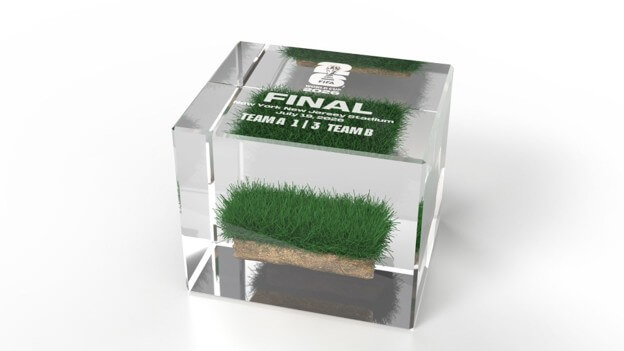
Picture by Manas Sen Gupta
While fans treasure these souvenirs because they represent football history, they also highlight something we rarely think about: the carefully managed soil beneath the grass made those unforgettable moments possible.
What Can Football Teach Us About Soil Security?
Every FIFA World Cup pitch receives months of scientific attention to ensure the soil performs exactly as required. Experts carefully manage soil structure, water, nutrients, biology, and compaction so players can perform at their very best.
Imagine if we gave the same level of care and attention to the soils beyond the stadium.
Just as carefully managed soil provides the foundation for a world-class football pitch, well-managed and secure soils provide the foundation for a healthy planet. They continuously produce our food, store carbon, filter water, support biodiversity, and sustain the ecosystems on which all life depends. This is the idea behind Soil Security, recognising soil as one of our most valuable natural resources and ensuring it is protected and managed to safeguard the health of our planet and future generations.
Conclusion: From the Pitch to the Planet
The next time you watch a football match, remember that the beautiful game doesn’t begin with the players; it begins beneath their feet. And perhaps one of the greatest lessons the FIFA World Cup can teach us is that when we care for our soils, they perform at their best, and so does our planet.

by Thilini Jayasekara
PhD Candidate at the University of Sydney
Thilini holds a Bachelor’s degree in Agricultural Technology and Management from the University of Peradeniya, Sri Lanka, and a Master’s degree in Environmental Soil Science from the same university. She is currently pursuing her PhD at the University of Sydney. Her doctoral research focuses on how climate change affects soil indicators and functions, and how these impacts pose a threat to soil security.