
Shaping the Future of Global Soil Security: Aroura’s Third Summit
From exploring ancient soils in the Blue Mountains to discussing a Declaration on the Rights of Soil, the Third Global Soil Security Summit brought together international experts to advance a shared vision for protecting one of our planet’s most vital resources.
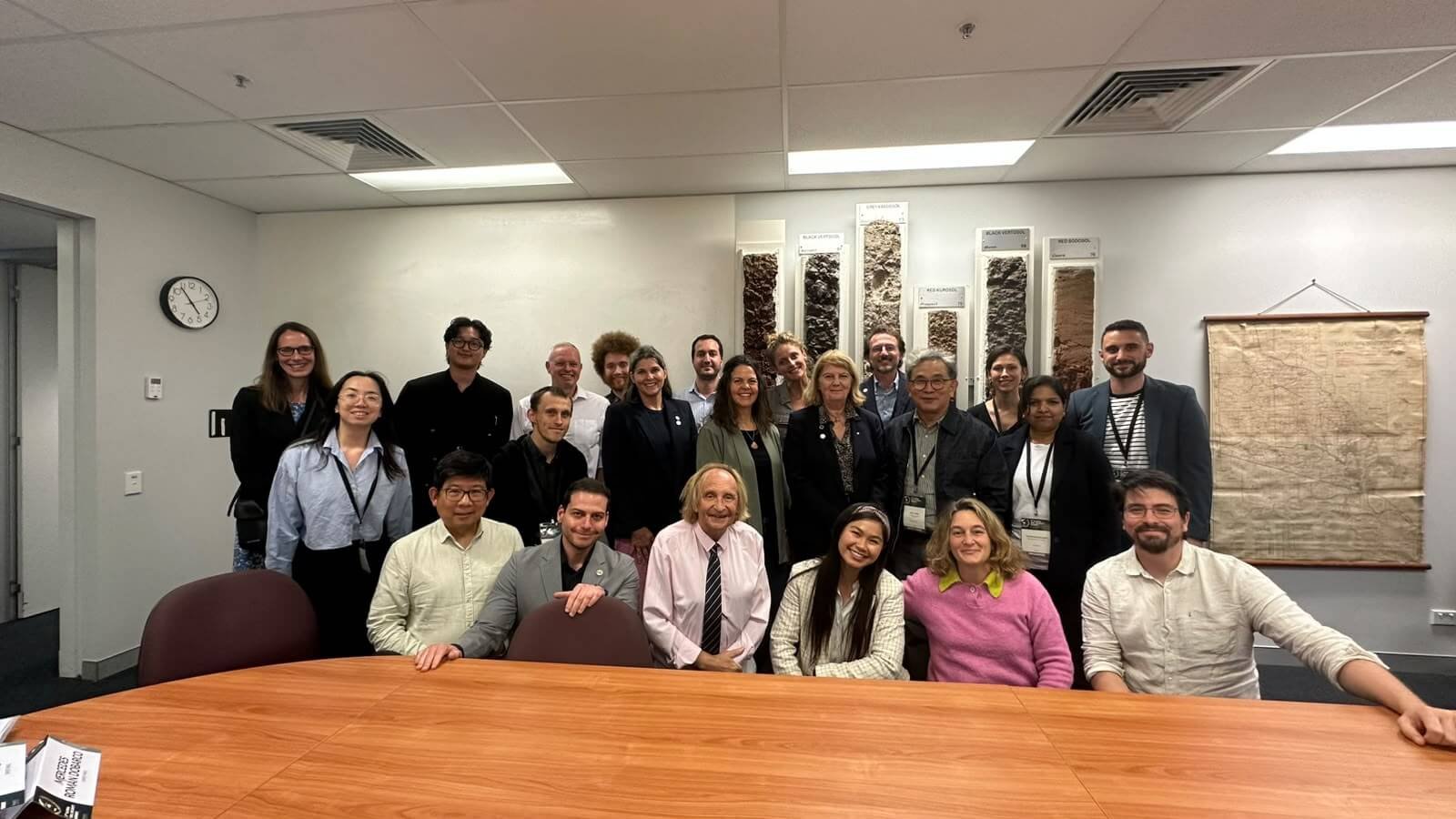
From 20 to 23 October 2026, the University of Sydney hosted the Third Global Soil Security Summit, bringing together members of Aroura, the Global Soil Security Think Tank, for four days of collaboration, scientific exchange and forward-thinking discussions on how to secure the world’s soils for future generations.
Recognising the urgent need for coordinated global action, the Summit provided an opportunity to reflect on progress, tackle emerging challenges and explore how scientific knowledge can be translated into meaningful policy and practical solutions.
A Growing Global Community for Soil Security
Recently established as a centre at the University of Sydney, Aroura brings together an international panel of 15 leading experts spanning soil science, economics, law and social science. This diversity of expertise reflects a fundamental principle of soil security: protecting soils is not simply a scientific challenge, but also an environmental, economic, social and legal responsibility.
This year’s Summit welcomed two new experts to the panel: Dame Lorna Dawson, from Scotland, internationally recognised for her expertise in soil forensics, and Claudio Zucca, a distinguished professor in pedology from Sardinia, Italy. Their contributions further strengthen Aroura’s interdisciplinary and international perspectives.
The Summit also provided an opportunity to celebrate the Think Tank’s achievements over the past year. Aroura members have contributed seven peer-reviewed publications exploring important dimensions of soil security, including pathways towards a global convention to secure soil, frameworks for developing national soil security strategies, and the connections between soil security and major global challenges such as climate change and biodiversity loss.
Together, these contributions provide a growing scientific foundation for advancing soil security from a conceptual framework towards practical action.
Rethinking Soil Security for a Changing World
A central theme of this year’s discussions was how the Soil Security framework can evolve to respond to an increasingly complex and rapidly changing world.
Participants explored the importance of soil resilience, environmental thresholds and the potential for soil recovery following degradation. Discussions also highlighted the intricate relationships between soils, ecosystems and human societies, recognising that soil security must be understood within the broader environmental and social systems it supports.
Another important focus was the development of practical tools and regionally adapted approaches that can help countries and communities assess, monitor and improve soil security.
With soils varying enormously across landscapes, climates and land uses, participants emphasised the need for approaches that are scientifically robust while remaining flexible enough to respond to different national and local contexts.
Learning from Nature: A Field Visit to Mount Wilson
One of the highlights of the Summit took participants beyond the meeting room and into the remarkable landscapes of Mount Wilson in the Blue Mountains.
Here, participants explored soils that have experienced relatively minimal human disturbance, offering valuable insights into what soil condition can look like in landscapes less affected by intensive land use and management.
These soils provide important reference states against which changes in soil condition can be assessed and mapped. By examining relatively undisturbed soils, researchers can better understand how human activities have altered soil properties and functioning over time.
The field visit offered an opportunity to connect scientific discussions with observations in the landscape, reinforcing the importance of reference soils in developing meaningful approaches to soil assessment and monitoring.
It was also a reminder that understanding how to protect and restore soils begins with understanding the natural systems from which they develop.
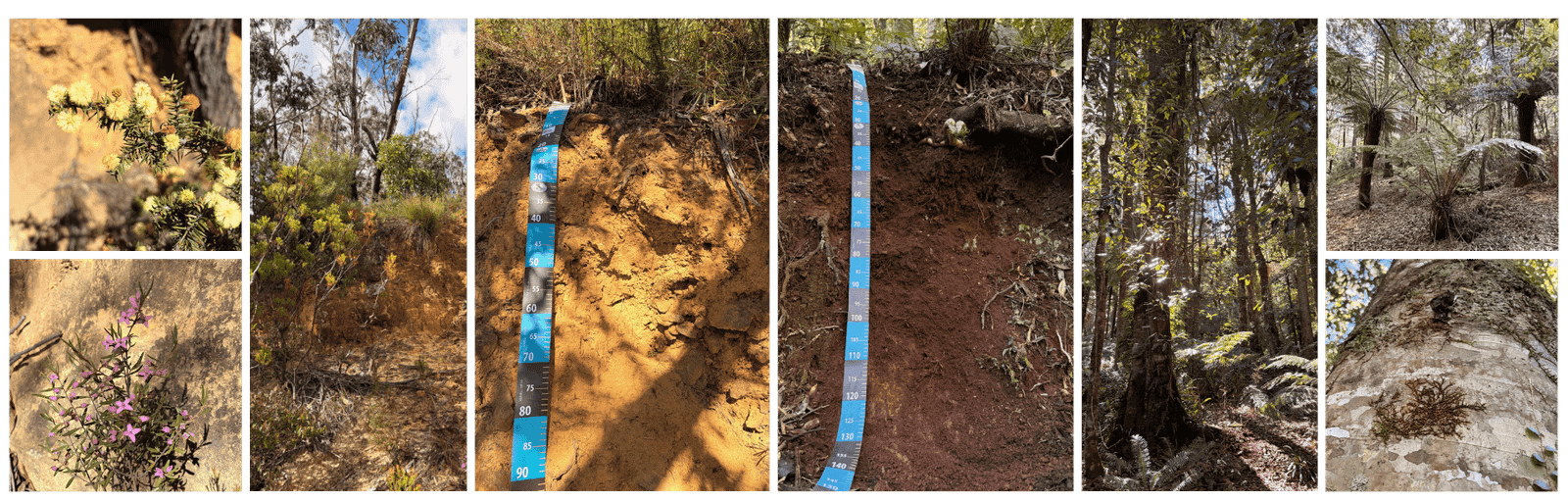
Two contrasting soils explored during the Mount Wilson field visit. LEFT: A shallow, sandy Dermosol developed on Narrabeen sandstone on the surrounding plateau, supporting eucalypt bushland. RIGHT: A deep, red-brown clay loam soil derived from basalt on the Mount Wilson cap, supporting rainforest vegetation.
Could Soil Have Rights?
Among the Summit’s most thought-provoking discussions was the first consideration of a proposed Declaration on the Rights of Soil.
The proposal opened an important conversation about the intrinsic value of soil and whether soil protection should extend beyond its recognised benefits to human society.
What would it mean to recognise soils as valuable in their own right? How might scientific understanding, ethical principles and legal frameworks work together to strengthen their long-term protection?
While these discussions are at an early stage, they represent an important opportunity to rethink humanity’s relationship with soils and explore new approaches to environmental stewardship.
By bringing scientific, legal and social perspectives together, Aroura is helping create space for conversations that extend beyond traditional soil management and towards a broader understanding of our responsibilities to the natural world.
Taking Soil Science Beyond the Scientific Community
Generating knowledge is only part of the challenge. Ensuring that knowledge reaches the people who can act on it is equally important.
Throughout the Summit, participants considered how soil security research could be communicated more effectively to policymakers, practitioners, educators and the broader public.
Ideas included developing accessible, plain-language summaries of scientific publications, strengthening science communication and producing a Soil Security textbook to support the education of the next generation of soil scientists.
These initiatives reflect a shared ambition to make soil security knowledge not only scientifically rigorous, but also accessible, practical and relevant to those making decisions about the future of our soils.
Building Partnerships for Global Action
International collaboration remained at the heart of the Summit.
Participants explored opportunities to expand the reach of soil security through the continued development of the Friends of Soil Security network, an initiative designed to enable individuals beyond the Think Tank to engage with and contribute to its mission.
Potential partnerships with institutions and organisations sharing similar objectives were also discussed, recognising that securing soils globally will require sustained cooperation across disciplines, sectors and borders.
Through these connections, Aroura aims to strengthen the bridge between research, policy and practice, helping ensure that advances in soil security knowledge lead to tangible outcomes.
From Scientific Understanding to Lasting Action
The Third Global Soil Security Summit demonstrated both the progress already made and the opportunities that lie ahead.
From advancing scientific frameworks and exploring reference soils in the Blue Mountains to opening conversations about the rights of soil, the four-day gathering reflected the breadth and ambition of the global soil security agenda.
Importantly, the Summit reinforced that soil security cannot be achieved through science alone. It requires collaboration between researchers, policymakers, practitioners, institutions and communities, supported by a shared commitment to protecting the soils on which life depends.
As Aroura continues to grow its international network and scientific contributions, the focus remains firmly on translating knowledge into action: strengthening partnerships, informing policy, improving soil stewardship and embedding soil security within global sustainability agendas.
The Summit concluded with a renewed sense of purpose and a shared commitment to ensuring that the world’s soils remain healthy, resilient and capable of supporting generations to come.
“Soil sustains us. Securing its future is our shared responsibility.”
by Nicolas Francos
Postdoctoral Researcher, Soil Security Laboratory, The University of Sydney
Nicolas is a Postdoctoral Research Associate at the School of Life and Environmental Sciences and the Sydney Institute of Agriculture (SIA). His current research focuses on soil security and the development of methods for estimating soil organic carbon sequestration using spectroscopy and remote sensing techniques. He completed his Bachelor's degree in Geography at the Hebrew University of Jerusalem and both his Master's and PhD at Tel-Aviv University. His graduate research focused on soil spectral modelling at various scales, ranging from laboratory analyses and field studies to remote sensing, utilizing both hyper- and multi-spectral resolutions from aerial and satellite imagery, combined with extensive field campaigns for ground truthing.
by Sandra Evangelista
Postdoctoral Researcher, Soil Security Laboratory, The University of Sydney
Sandra holds a Bachelor of Science in Agriculture and a PhD in Soil Science, both from the University of Sydney. Her research focus is on developing quantitative frameworks to quantify soil security. She also collaborates closely with researchers in India on the development of an AI-based monitoring platform for soil carbon sequestration.