
From Soil Health to Soil Security: Seeing the Bigger Picture
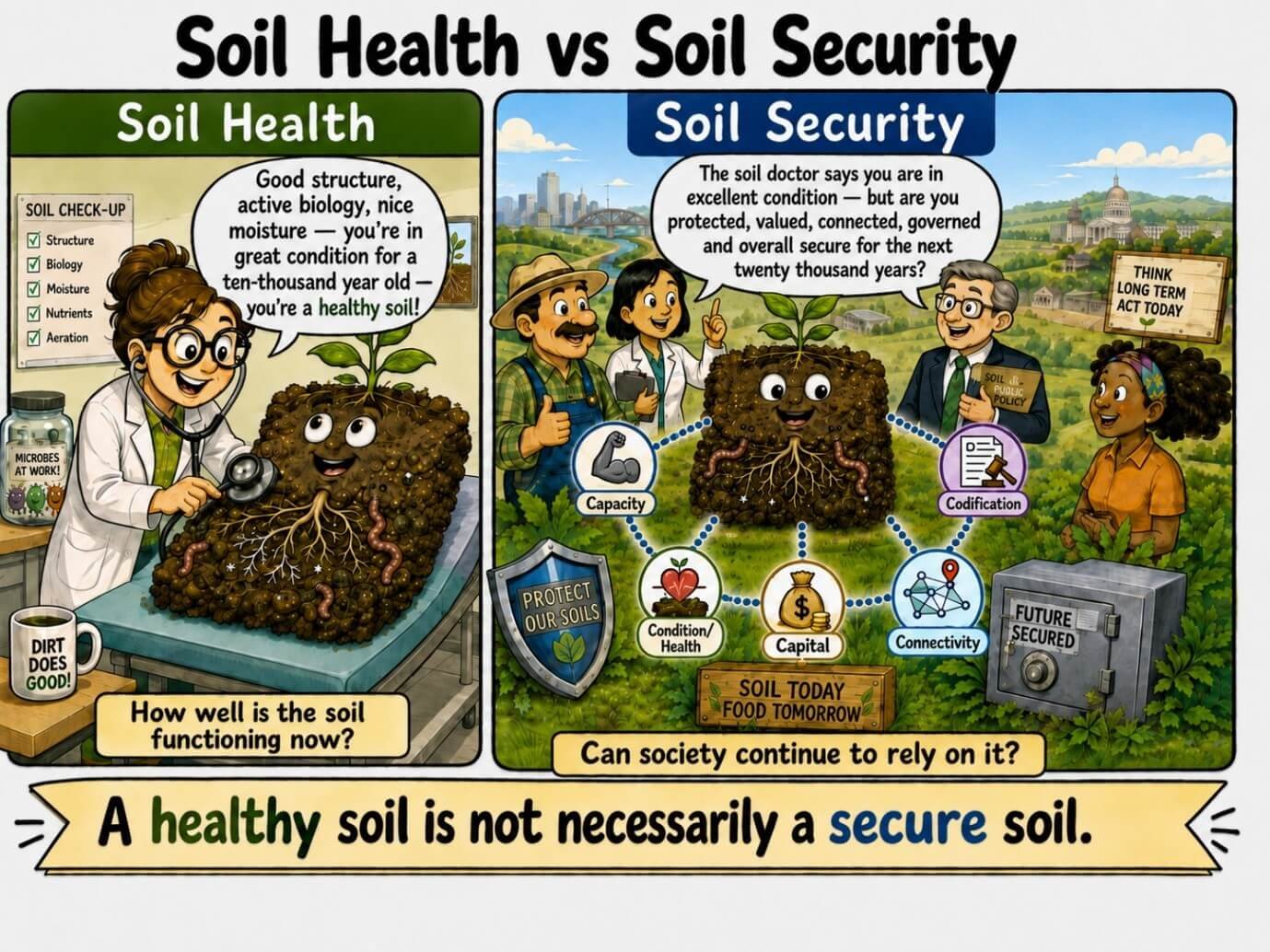
One of the recurring difficulties in talking about soil is explaining the difference between soil health and Soil Security. The two ideas are closely related, but they are not interchangeable. Soil health – or, perhaps more precisely, soil condition – describes the present state and functioning of a soil. Soil Security is the larger, more integrative idea. It includes condition/health, but also asks whether the soil has the capacity to perform the functions society requires, whether its value is recognised, whether people and institutions are connected to it, and whether adequate governance and protection are in place.
In other words, condition or health is a component of security, not an alternative to it.
That distinction can sound rather abstract, so analogies from everyday life may help.
A healthy person is not necessarily a secure person
Perhaps the most direct analogy is human health and human security. We can assess a person’s health from their physical and mental condition. But someone can be perfectly healthy and still be insecure. They may lack reliable food, housing, income, healthcare, legal protection or personal safety.
Health is therefore an essential part of human security, but it is not the whole of it.
The same is true of soil. A soil may presently have excellent structure, adequate nutrients, vigorous biological activity and good productivity – in other words, it may be in good health or condition. Yet it may still be insecure if it is being eroded, poorly governed, undervalued, threatened by future climatic change, or effectively invisible in the decisions that determine its future.
A house can be in excellent condition but housing can still be insecure
The house analogy may be even easier to grasp.
When we inspect a house, we can assess its condition: Is the roof sound? Are the foundations stable? Is the wiring safe? Is there damp? Does the plumbing work?
Those things matter enormously. But they do not tell us whether the household has housing security. That also depends on affordability, tenure, insurance, legal protection, maintenance capacity, access to services and vulnerability to future hazards.
A beautifully maintained house can still be insecure housing.
Likewise, a soil can be in very good health today while its longer-term security is poor.
This may be the most useful general metaphor because few people would confuse the physical condition of a house with the much broader idea of housing security.
A seaworthy ship does not guarantee a secure voyage
Another useful analogy is a ship and its voyage.
We can examine the condition of the ship: its hull, engines, electrical systems and navigation equipment. All must be healthy and functioning well.
But a secure voyage requires much more. There must also be a competent crew, reliable charts and information, fuel, weather forecasts, access to safe ports, finance, rules and contingency plans.
A ship in superb condition can still embark on a highly insecure voyage.
So too with soil. Good current condition is necessary, but it does not guarantee that the resource is secure into the future.
Financial health is only part of financial security
We already use almost exactly this distinction in everyday financial language.
A household’s financial health might be assessed from income, savings and debt. But its financial security depends on much more: employment stability, insurance, pensions, access to credit, legal protections and the ability to withstand unexpected shocks.
Financial health describes an important aspect of the present state. Financial security asks whether that state, and the benefits arising from it, can be sustained.
That is remarkably close to the distinction we need for soils.
Healthy food does not guarantee food security
A particularly useful analogy is food health and food security, because most people immediately recognise that the quality of food and the security of food supply are different questions.
We can ask whether food is healthy: Is it nutritious? Is it safe to eat? Does it provide the right balance of energy, protein, vitamins and minerals? Is it free from harmful contamination? These questions describe the health or condition of the food itself.
But food security is much broader. Perfectly nutritious and safe food may exist, yet people can still be food insecure if they cannot obtain enough of it, cannot afford it, cannot access it reliably, or if future supply is threatened by drought, conflict, transport disruption, market shocks or weak governance.
So healthy food is an essential part of a secure food system, but it does not by itself create food security.
The analogy with soil is very close. Soil health or condition tells us whether the soil is functioning well; Soil Security asks whether that functioning, and society’s continuing access to the benefits provided by soil, are secure.
A plate of healthy food is not the same thing as food security. Likewise, a healthy soil is not the same thing as Soil Security.
Ecosystem health is not the whole of environmental security
The same logic applies at a larger environmental scale.
We can assess the health or condition of a forest, river or wetland using measures such as biodiversity, productivity, ecological functioning or water quality. But environmental security also concerns protection, governance, societal dependence, competing uses, future threats and the institutional capacity to sustain the resource.
Again, health is nested within security.
The common idea behind all these metaphors
Across all these examples, the distinction is fundamentally the same:
Health or condition asks: How well is it functioning now?
Security asks: Can that functioning, and the benefits we derive from it, be protected and sustained?
This is why Soil Security is necessarily broader than soil health
For soil, condition/health sits alongside the other dimensions of Soil Security:
- Capacity – what the soil is inherently capable of doing;
- Condition/health – how well it is functioning now;
- Capital – the value of the soil and the benefits that flow from it;
- Connectivity – how well people understand, engage with and make decisions about soil;
- Codification – the governance, institutions, policy and legal arrangements that protect it.
A soil can therefore be healthy but insecure, just as a person can be healthy but insecure, a house can be structurally sound but provide insecure housing, a seaworthy ship can undertake an insecure voyage, or healthy food can exist within an insecure food system.
Perhaps that gives us the simplest message of all:
Soil health tells us how the soil is doing. Soil Security tells us whether we can continue to rely on it.
Or, even more succinctly:
A healthy soil is not necessarily a secure soil.
Read more: , , , et al. 2026. “ Soil Health Within Soil Security.” European Journal of Soil Science 77, no. 3: e70340. https://doi.org/10.1111/ejss.70340.
by Alex McBratney
Professor of Digital Agriculture & Soil Science ARC Laureate Fellow
Alex McBratney holds BSc, PhD and DSc degrees in soil science from the University of Aberdeen in Scotland, and the DScAgr degree from the University of Sydney for research in precision agriculture. He has made major contributions to soil science and agriculture through the development of the concepts of Pedometrics, Digital Soil Mapping and Precision Agriculture.