
How Spectroscopy Secures Soils Assessing Soil Capacity (Quality) and Condition (Health)
Photo of Ho Jun Hang from The University of Sydney
Soil is far more than just “dirt.” It is a living ecosystem critical for food security, water security, and climate regulation. However, traditional laboratory soil analysis is often slow, expensive, and environmentally taxing.
The solution? Soil Spectroscopy. This technology allows us to “read” the soil using light, providing a rapid way to estimate both its Capacity (quality) and its Condition (health).
The Concept of the “Spectral Fingerprint”
Every component in the soil—organic matter, clay minerals, moisture, carbonates, and iron oxides—interacts with light in a specific way. When we shine light on a soil sample, it absorbs and reflects on different wavelengths based on it composition. This creates a spectral fingerprint unique to that specific soil sample.
The Science: VNIR, SWIR & MIR
To get a full picture of what’s happening underground, scientists look at key regions of the electromagnetic spectrum:
- VNIR (Visible and Near-Infrared, 400–1000 nm): Generally used for detecting iron oxides and soil organic carbon. This is the range most commonly used by drones and satellites, and it is also used in the field for ground truthing aerial/satellite observations.
- SWIR (Short-Wave Infrared, 1000–2500 nm): Commonly utilized for identifying and quantifying clay minerals and inorganic carbon.
- MIR (Mid-Infrared, 2500–25000 nm): MIR provides much sharper data for quantifying organic carbon, pH, and mineralogy, making it a more accurate technology for soil analysis.
Estimating Capacity (Quality) vs. Condition (Health)
A key advantage of spectroscopy is its ability to distinguish between two vital aspects of the land:
- Soil Capacity (Quality): These are the inherent properties that don’t change easily, such as texture (sand/silt/clay content) and geological origin. This defines what the soil is capable of doing.
- Soil Condition (Health): These are dynamic properties that change based on how we manage the land, such as organic carbon levels, nitrogen content, and microbial activity. This tells us how healthy the soil is right now.
By shifting from wet chemistry to spectroscopy, carbon sequestration and nutrient levels can be monitored in near-real time, giving farmers and scientists a better understanding of soil capacity and condition and enabling faster, cheaper, and more accurate decisions.
Conclusion: More than just ‘data’
By unlocking the spectral fingerprints of our soils, we are moving toward a more sustainable future. Spectroscopy isn’t just about measuring data; it’s about understanding one of the foundations of life on Earth.
Reference and further reading: To learn more about how soil spectroscopy contributes to secure soils, check out the full research paper here:
👉 Evangelista, S.J., Francos, N., Sharififar, A., Ng, W., Minasny, B., McBratney, A.B., 2025. Advancing Soil Security with Soil Spectroscopy: The efficient estimation of indicators. Soil Security 21, 100211. https://doi.org/10.1016/j.soisec.2025.100211
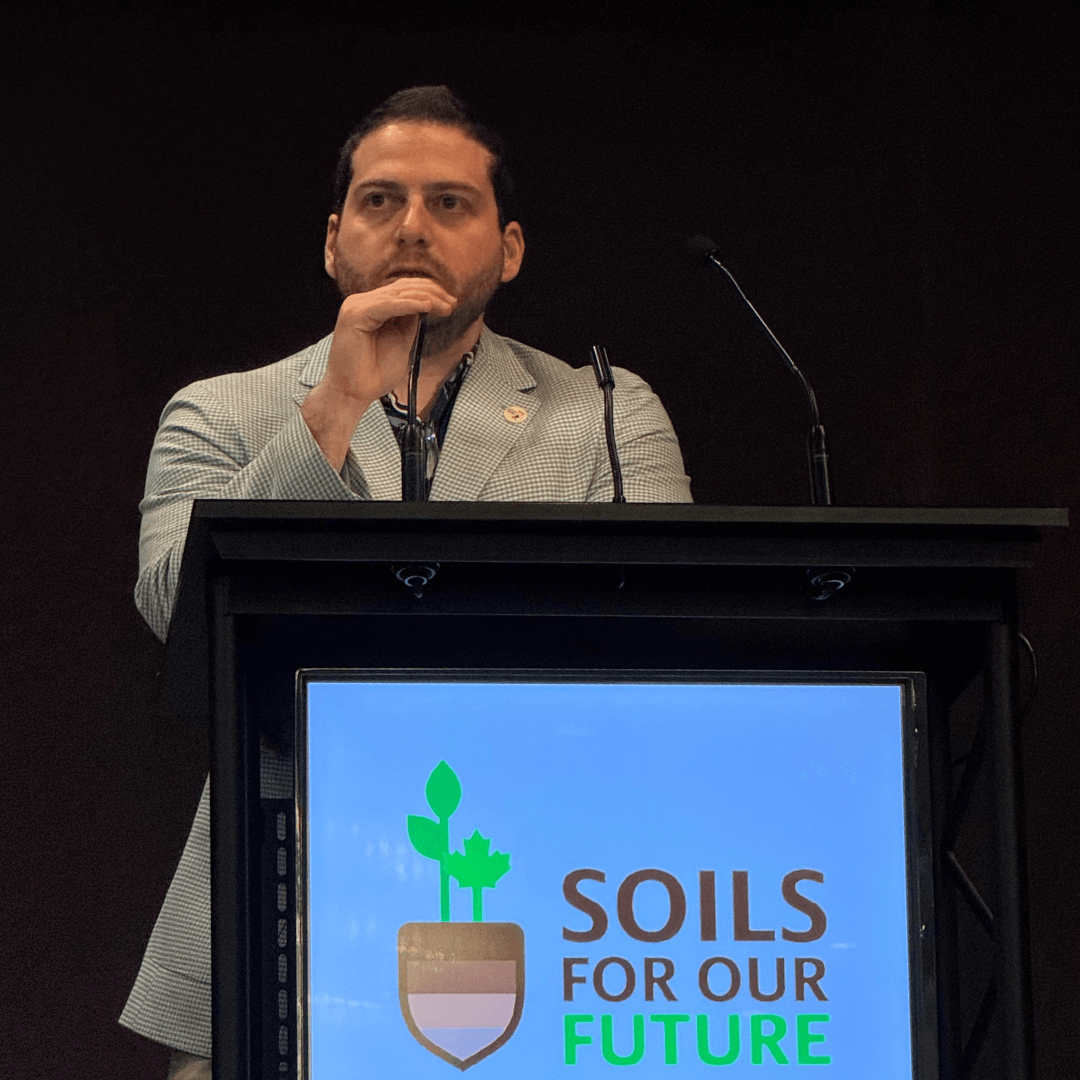
by Nicolas Francos
Postdoctoral Researcher, Soil Security Laboratory, The University of Sydney
Nicolas is a Postdoctoral Research Associate at the School of Life and Environmental Sciences and the Sydney Institute of Agriculture (SIA). His current research focuses on soil security and the development of methods for estimating soil organic carbon sequestration using spectroscopy and remote sensing techniques. He completed his Bachelor's degree in Geography at the Hebrew University of Jerusalem and both his Master's and PhD at Tel-Aviv University. His graduate research focused on soil spectral modelling at various scales, ranging from laboratory analyses and field studies to remote sensing, utilizing both hyper- and multi-spectral resolutions from aerial and satellite imagery, combined with extensive field campaigns for ground truthing.