
Zhejiang University visits the University of Sydney: a three-day Soil Security intensive with Aroura
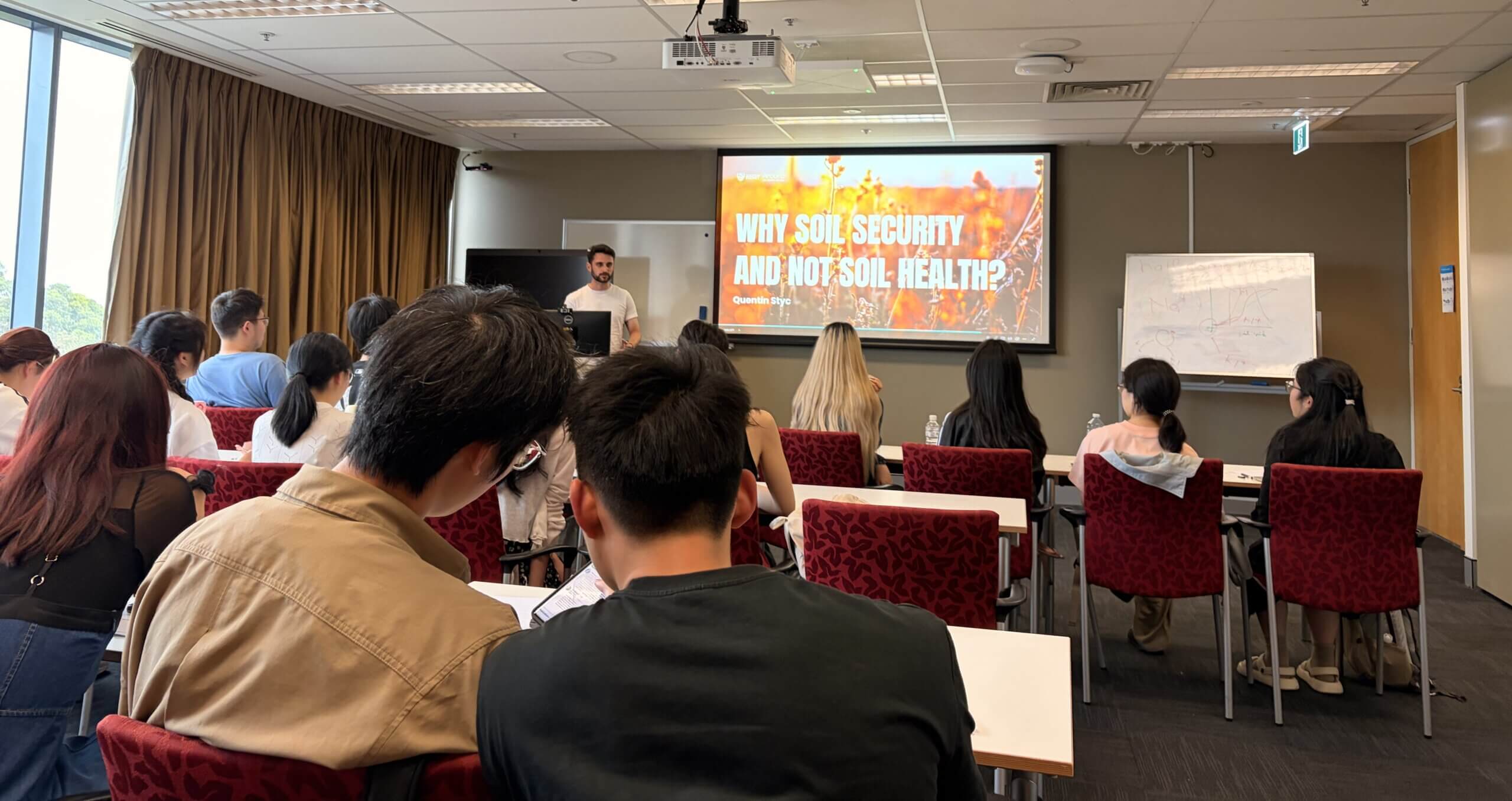
Zhejiang University students with the Aroura Expert Panel and Secretariat at the University of Sydney, following our two-day Soil Security intensive.
Last week, we had the pleasure of welcoming a group of students from Zhejiang University to the University of Sydney for the first three-day intensive workshop on Soil Security anywhere in the world. Hosted as part of a dedicated Soil Security course experience, the visit created an energising space for shared learning—bringing together different disciplinary backgrounds, different agricultural contexts, and a common interest in one of the most foundational (and most underestimated) assets we have: soil.
For Aroura, moments like this sit right at the heart of why we exist. Soil security is not a slogan; it is a framework for turning complex soil challenges into coordinated action—linking science, policy, measurement, and on-ground decision-making.
Over two concentrated days, we moved from first principles to practical application, and then out into the field to connect the framework with real landscapes and real trade-offs.
Day 1: Fundamentals – building a shared language for Soil Security
We opened the first day by establishing a common foundation. Soil Security can mean very different things depending on whether you approach it as a soil scientist, an agronomist, a policy-maker, an engineer, or an economist. So the first task was to build a shared language—one that is rigorous enough to guide research and decisions, but accessible enough to work across disciplines and borders.
The session focused on the fundamentals: what Soil Security is, why it matters, and how it differs from (while complementing) adjacent ideas like soil health, land degradation neutrality, and climate-smart agriculture. We explored how soil sits at the intersection of food systems, water security, biodiversity, climate mitigation and adaptation, and rural livelihoods—and why soil outcomes are often “everywhere” in policy, yet still “nowhere” in accountability.
From there, we discussed the logic of frameworks: why we need structured ways to identify risks, prioritise investments, and track whether interventions are actually improving outcomes over time. The aim was not only to teach definitions, but to equip students to ask better questions—questions that are measurable, comparable, and decision-relevant.
By the end of Day 1, we were all working from the same core idea: Soil Security is about the capacity of soil to continue to deliver essential functions and services—reliably, equitably, and over the long term—under changing environmental and socio-economic conditions.
Day 2: Into the field – visiting our Hunter Valley Sites
A highlight of the visit was the second day where the students were given an opportunity to travel to the Hunter Valley and see landscapes and sites where we have previously worked. Field time matters in Soil Security because soil is not abstract: it is physical, variable, and deeply shaped by land use history and management choices.
In the Hunter Valley, students could connect workshop concepts with what is visible on the ground—soil variability across a landscape, signs of constraint and resilience, and the kinds of practical considerations that shape real land management decisions.
Seeing soils in situ makes the key lesson unavoidable: frameworks are only useful if they make sense in the field, under time constraints, budget constraints, and competing priorities.
The visit created space for thoughtful comparison too. Students brought insights from Chinese agricultural systems and soil management contexts, and those perspectives sharpened our own thinking about what travels well across regions—and what must be adapted.
This kind of exchange is exactly where Soil Security becomes global in the most productive sense: not a one-size-fits-all model, but a shared approach to diagnosis, prioritisation, and accountability.
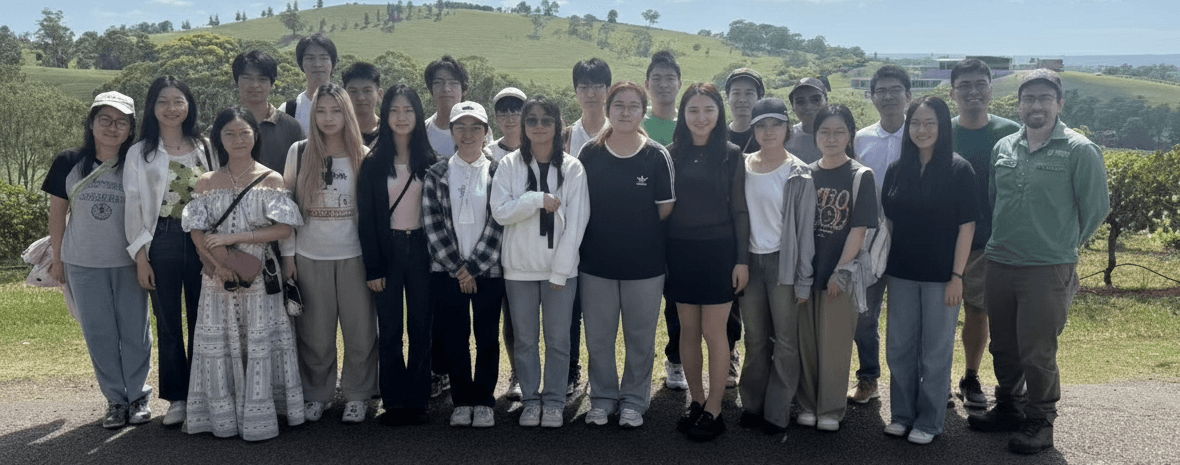
Zhejiang University students during their visit to the Hunter Valley
Day 3: Practical applications – turning concepts into tools and decisions
Day 3 shifted from “what it is” to “how it works”. This was the practical, applied side of Soil Security: how a framework becomes something you can use when you are making decisions about land management, monitoring programs, investment priorities, or policy settings.
We worked through how Soil Security can be operationalised in real contexts: defining the purpose of an assessment, selecting indicators that match that purpose, and designing evidence pathways that are credible and repeatable.
The emphasis was on a key point that is easy to miss: measurement is not the goal—decision support is. Data only becomes valuable when it changes what we do, where we invest, and how we learn.
The workshop also demonstrated the types of evidence that Soil Security draws upon—field observations, lab analyses, spatial data, and decision frameworks—and how these can be integrated without losing transparency. Students engaged with examples of how Soil Security can be applied to support land managers, industry groups, governments, and communities. The takeaway was that practical application does not mean simplifying reality; it means structuring complexity so that choices become clearer.
Just as importantly, the discussion highlighted how Soil Security invites a wider lens than technical soil properties alone. It asks us to consider not only the state of soil and the threats it faces, but also the enabling conditions for action: the institutions, incentives, and capacity needed to protect soil as an asset over time.
What This Means for Aroura
Aroura’s mission is to elevate soil security to the global agenda and strengthen the pathways from science to implementation. Hosting visiting cohorts is one of the most direct ways to do that. It builds the next generation of leaders who can work confidently across disciplines and translate soil knowledge into action in government, industry, and research.
It also reminds us that Soil Security is inherently collaborative. Soils do not respect institutional boundaries, and neither do the challenges that degrade them. Whether we are talking about food resilience, climate risk, biodiversity loss, or water quality, the same principle applies: protecting soil requires shared methods, shared evidence standards, and shared commitment.
Looking ahead
We are grateful to the Zhejiang University students for their curiosity, engagement, and generosity throughout the workshop, and to our colleagues at the University of Sydney who helped make the program possible. We hope this visit is the start of deeper collaboration—through continued exchange, joint learning opportunities, and future projects that connect Soil Security research with practical outcomes.
If you are interested in partnering with Aroura on Soil Security training, workshops, visiting programs, or collaborative projects, we would love to hear from you. Soil Security is a global challenge—but it is also a global opportunity, and progress accelerates when we learn together.
Aroura — advancing Soil Security through interdisciplinary collaboration, practical frameworks, and global advocacy.
by Daniel Park
Administrative Officer
Daniel (Minhyung) Park works with the Soil Security group in the School of Life and Environmental Sciences at the University of Sydney, where he helps coordinate research, events and funding around soil security. He is currently studying a combined Bachelor of Commerce and Laws, with interests that span environmental law, finance and governance. Daniel is closely involved in developing Aroura, a soil security think tank focused on bringing soil onto the global agenda, and collaborates with researchers, students and partners across disciplines. Alongside his university roles, he has experience in consulting, and education, and has taught a wide range of students over several years.
Related Articles
Exploring a Soils Story – Sydney Olympic Park
Everyone has a place that is able to evoke emotions unlike any other. That place of intrigue and nostalgia, passion and calm, all rolled into one truly unique location. For me, that place might just be Sydney Olympic Park. Situated 13 km west of Sydney, it is a...
Soil Security and the 4 per 1000 initiative: Making Climate Gains Last
Last November marked a major milestone for the International “4 per 1000” Initiative, which celebrated ten years of promoting soil carbon as a tool for climate action, food security, and sustainable development. This is because soil carbon is arguably one of the key...
Soil and the Cities: soil’s significance in every day’s life
Soil: The Unsung Hero of Human Survival Soil is everywhere beneath our feet, but most of us rarely give it a second thought. Yet, this humble dirt is the silent foundation of life on Earth. It grows our food, filters our water, and even plays a major role in keeping...